
Show Notes
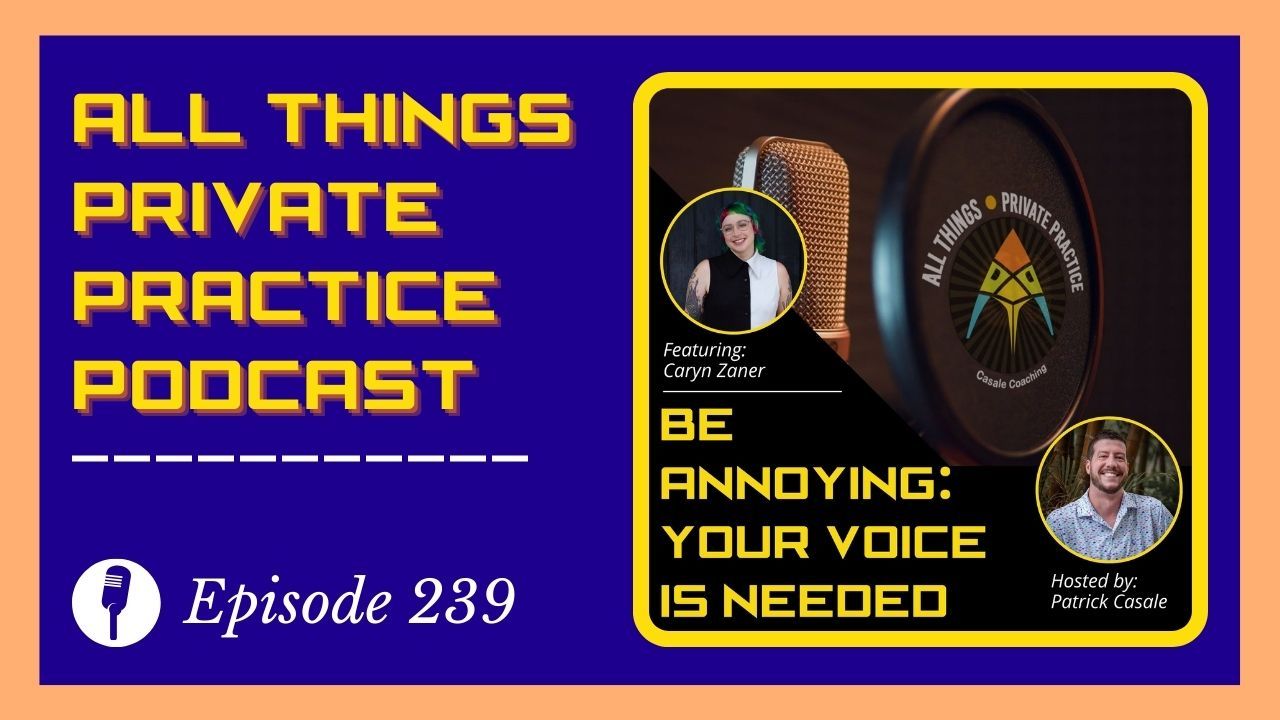
In this episode, Patrick Casale talks with Caryn Zaner, PsyD, founder of Therapy for the Apocalypse and Felt Not Fixed, about what it means to run a business—and a life—rooted in values, authenticity, and a commitment to community, especially while navigating the challenges of a capitalist system that isn’t designed for equity or collective care.
Here are 3 key takeaways:
- Embrace Value Alignment, Even When It’s Hard: If your business decisions don’t feel authentic or congruent with your values, it’s nearly impossible to stay motivated or feel good about your work. It’s okay to leave “money on the table” if it means staying true to yourself.
- Community and Accessible Care Matter: Healing happens in relationships, not isolation. The use of equitable sliding scales and group therapy can make care more accessible and build genuine community in and out of the therapy room.
- Rejection is Part of Advocacy: Practice advocating for yourself, even if it feels “annoying.” Not everyone will be your people—and that’s by design. Standing up for what truly matters means you’ll attract your “right fit” clients and repel those who aren’t aligned. That’s how you create real impact.
Let’s dare to be a bit more “annoying”—and a lot more authentic—in our work and our lives.
More about Caryn:
Caryn Zaner, PsyD, is a psychologist who runs Therapy for the Apocalypse (a private therapy practice) and Felt Not Fixed (a coaching and consulting project still finding its shape).
In their clinical work, they offer virtual services for Oregon-based clients, specializing in group therapy and therapeutic intensives for people navigating identity transitions, relational and attachment trauma, and existential distress. Their approach integrates Emotionally Focused Individual Therapy (EFiT), existential-humanistic principles, and relational process work, informed by liberational and feminist psychologies.
Through Felt Not Fixed, Caryn offers coaching, consulting, and facilitation for people and teams who want to live and work in closer alignment with their values. This branch of their work centers on emotional authenticity, community connection, and creative experimentation.
Across both spaces, Caryn helps people move from intellectual understanding to felt experience and from isolation to real contact.
Offer:
Check out Felt Not Fixed, a coaching and consulting space for values-driven humans, practitioners, and teams. It’s where Caryn (will) host evolving offerings like Values Clarity Sessions, Improv-based Perfectionism Recovery Workshops, and community-oriented groups on emotional processing and queer belonging.
For Oregon residents seeking therapy, Caryn offers group therapy and therapeutic intensives rooted in relational and existential-humanistic work.
- Website: carynzanerpsyd.com
- Felt Not Fixed Coaching: feltnotfixed.podia.com
- Instagrams: @therapy.for.the.apocalypse and @felt.not.fixed
🎙️Listen to more episodes of the All Things Private Practice Podcast here
🎙️Spotify
🎙️Apple
🎙️YouTube Music
▶️ YouTube
✈️ Check out available Retreats
🗨️ Join the free Empowered Escape FB Community
🗨️ Join the free All Things Private Practice FB Community
A Thanks to Our Sponsors: The Receptionist for iPad, Alma, & Portland, Maine, Summit 2026!
I want to thank The Receptionist for iPad for sponsoring this episode.
The Receptionist for iPad is a HIPAA-ready digital check-in system that eliminates the need to walk back and forth from your office to the waiting room to see if your next appointment has arrived. Clients or patients can check in for their appointments, and you'll be immediately notified by text, email, or your preferred channel. Break free from interruptions and make the most of your time, because it is valuable. Start a free 14-day trial of the Receptionist for iPad by going to thereceptionist.com/privatepractice. Make sure to start your trial with that link to get your first month free if you decide to sign up.
✨Alma
Thanks to Alma for sponsoring this episode.
Alma empowers you to confidently accept insurance backed by an all-in-one EHR that simplifies scheduling, documentation, and day-to-day practice operations. With a network of engaged providers and free CE courses, Alma makes it easy for you to build the practice of your dreams on your terms. Alma believes that when therapists get the support they need, mental healthcare gets better for everyone. Learn more at helloalma.com/ATPP.
The 2026 Doubt Yourself Do It Anyway Summit is happening for the first time in the United States in beautiful Portland, Maine, on September 1st–3rd, 2026. Portland, Maine, is a beautiful coastal city in the Atlantic Ocean. There's a lot of history there, and it's a very funky, creative, safe, walkable, diverse, and progressive city. You will get 9 NBCC CEs. We have ASWB pending—we'll make an announcement when that's finalized—and have 13 prolific industry leaders. This summit has always been about showing that our skills are applicable in so many different ways, and to motivate you to think bigger, grow in this profession, take more risks, work through self-doubt, and really embrace the doubt-yourself-do-it-anyway mentality. Spots are limited. Reserve your spot here: empoweredescapes.com/portland-maine-summit
Doubt yourself. Do it anyway. See you in Maine.
Free Gifts for Our Listeners
Get a practical podcasting workbook for therapists considering starting a podcast, created by Patrick Casale, host of the podcasts All Things Private Practice and Divergent Conversations.
You'll get a practical structure for therapists who want to start a podcast but don’t want to rush, perform, or build something they can’t sustain.
Grab your free copy: atppod.com/free-podcasting-workbook
✨ Move Beyond Private Practice As A Neurodivergent Entrepreneur
Move Beyond Private Practice As A Neurodivergent Entrepreneur is a FREE 5-part mini-course designed for therapists who want sustainable financial independence beyond one-on-one work.
Access your free mini-course here: atppod.com/move-beyond-private-practice-free
Transcript
PATRICK CASALE: Hey, everyone. Welcome back to the All Things Private Practice podcast. I'm joined today by Caryn Zaner, PsyD, is a psychologist who runs Therapy for the Apocalypse, which I fucking love that name, a private therapy practice. And Felt not Fixed, a coaching and consulting project still finding its shape.
In their clinical work, they offer virtual services for Oregon-based clients specializing in group therapy and therapeutic intensives for people navigating identity transitions, relational attachment trauma, and existential distress. I can't say the word today, existential distress. Their approach integrates emotionally-focused individual therapy, existential humanistic principles, and relational process work formed by liberation and feminist psychologists.
Through Felt not Fixed, Caryn offers coaching, consulting, and facilitation for people and teams who want to live and work in closer alignment with their values. This branch of their work centers emotional authenticity, community connection, and creative experimentation.
Okay, cool. Welcome to the show. So, I met you last year, two years ago, at a retreat that I was hosting in Spain. Really enjoyed, like, some of the buildup questions and conversation that we had before that, and then getting to meet you in general, and spending time with you. It's obvious how apparent, like, authenticity matters for you, but more importantly, your values influence and inform everything that you do, not only personally, but professionally. And that obviously shows up in your social media content as well. So, I think we're talking about the combination of authenticity, values alignment, and working in a capitalist world, or hellscape. Maybe we'll say that.
CARYN ZANER: We can say hellscape.
PATRICK CASALE: We can say hellscape. So, tell us about what that means for you, while not only like building your businesses and your therapy practice, but informing who you are as a human.
CARYN ZANER: Yeah, I think, like many of us in the field, we get into the work to help people. And so, for me, starting and running two businesses has been continuously grappling with, well, I need to make money in order to help people. And the service that I'm providing, I believe, should be provided to everyone at any time, and yet we don't live in that world.
PATRICK CASALE: Yeah.
CARYN ZANER: So, having to navigate that for myself, and not wanting to be extractive, and also, I like having my little treats.
PATRICK CASALE: We do need to have our little treats, right?
CARYN ZANER: Your therapist needs to be having their little treats.
PATRICK CASALE: Yeah, whatever that means for you out there while you're listening. I think that is absolutely true. I think you are not alone in finding yourself in this almost moral and ethical dilemma of, I need to have my little treats. I need to take care of my needs. I need to feel like I have what I need to do the job that takes a lot out of me. And… I don't exactly believe in the system that I am participating in.
CARYN ZANER: Yeah, 1,000%. And I think I see you maybe grappling with it, too, on your social media. It seems like important that you're also making explicit political statements. And I decided early on that I'm not going to not do that. I believe the whole practice and service is political. So, it feels impossible not to bring that in.
PATRICK CASALE: I almost want to go down the rabbit hole of like, is therapy political, and like, you know, obviously, the answer is yes, a resounding yes. And I know some of you listening are like, “Absolutely not. We need to keep it out of the therapy room.”
And we're not going to have that conversation today, but if that is your take, we're probably not in alignment in that regard.
So, this is challenging. And I've had a lot of people on recently who are navigating similar experiences. And I employ a lot of therapists who are also navigating this for themselves, but also, trying to help their clients navigate this of like, “I need my basic needs met.” And I want more than that. Like I feel like I want more than my basic human needs met. I want to feel at least some sense of comfort and relief in this lifetime, and by participating in a for-profit practice, by participating in a coaching business, whatever makes money, contributing into capitalism.
And I think for me, what I've had to grapple with is like, how do we try to, like, level the playing field, so to speak? How do I try to make more equitable, accessible resource and care, while also simultaneously knowing that I have to pay my fucking mortgage? Easier said than done sometimes.
CARYN ZANER: For me, it's been really important to draw from existing practices, what's already out there. I do not have to reinvent the wheel. There have been sustainable mutual aid circles existing for forever.
And I borrow from, I think their name is Alexis J. Cunningfolk and Brit something. I can send it to you later. But their model of like the green bottle sliding scale and equitable sliding scale, it feels really important to me to have my clients who are in tech, in big med, and big pharma. Like, like those clients who can afford, my lawyer clients. Like, they can [CROSSTALK 00:06:56]-
PATRICK CASALE: Yeah.
CARYN ZANER: …more. And then, the queer, trans, BIPOC clients who can only pay $10 a session, pay $10 a session. So, like, that's how I try, and I still grapple with, like, is that enough?
PATRICK CASALE: Yeah, absolutely. And I think it's about trying to, like, figure out that pendulum, right? And figuring out if those clients are paying more because they have more means and resources than this population, who has less access or a harder time, in general, in society right now, especially, then it allows them to get the care that they need.
And I know you run a lot of groups as well. And I think groups are a great way to create more accessibility. And I also think they also help create community care, which is so often lacking and missing. And if we talk about the mental health industrial complex of like, the only way to get better is one-on-one therapy. And you do this one-on-one therapy once a week for the rest of your life, that's not really sustainable for most people, in general, for a variety of reasons. And what we really do need more than ever right now, in my belief, is community. We need connection.
CARYN ZANER: I 1,000% agree. I think, as an EFT, emotionally focused therapy [INDISCERNIBLE 00:08:18] and like relational clinician, I think healing has to happen in relationship. And while one-on-one therapy can be incredibly helpful and healing, I also cannot help but pay attention to the ways that it replicates rugged individualism, right? Like, if you work on yourself, and if you become your most enlightened self, then everything's better.
PATRICK CASALE: Yeah.
CARYN ZANER: And I think that has value and merit, right? Like, I know for myself, I wish that I had had more queer elders. I wish that I had had more mentorship. I wish that I had had more cross-generational experience. And I still wish that, like, now that I'm getting older, I wish that I had that too. And I hear that from almost every client.
PATRICK CASALE: Absolutely.
CARYN ZANER: …for the last 10 years, that like, “I don't know how to find my people. I don't know how to fit in. Everyone already has friends. They don't want me. Where do I fit in?” And with group, I can just kind of, like, make all my clients play with one another and, like, do it in real time.
PATRICK CASALE: I don't think you're alone in that. I can't tell you how many times I've heard from therapists like, “I wish I could just pair this client up with this client so they could be friends, because, you know, they would really enjoy each other, and support each other. “
And even when I was doing coaching work, like, that's why I always preferred group coaching over individual coaching, just to see the milieu, and just to see the connection, and the camaraderie that got established.
And honestly, that's why I started doing retreats, was because I was like, “I want connection and community. I want to do it in these cool locations. I have the privilege to be able to. And I would love to help people get into that place where they can also do the same.”
And that, if we're talking about capitalism too, and equitability is why I've always tried to give like, one or two free spots away to the BIPOC, queer, trans community, the autistic community, people who just can't afford to come on an experience like that sometimes. And that was the only way I can make sense of like, if I'm going to charge X amount of money for these events, I've got to balance the scale, so to speak, because I don't think I can live with myself if I'm just like raking in money hand over fist.
CARYN ZANER: The sticky part of having values that you care about is having to deal with that yourself, right? Like, for me, at least, the turmoil that I can cause, is this the right thing within my idea of what pro-social and moral means? Right? Like, am I living in alliance with my values? And for me, I feel ill when I feel like I'm not. So, it is such a visceral feeling that drives things like that. And honestly, I know it's not good for business, but I don't know what else to do.
PATRICK CASALE: Yep, that's a really important point. And I'm glad you made that. I know it's not good for business, but I don't know what else to do. I have, you know, well, not unfortunately, I've made a lot of decisions in my business career, where I've, like, firmly entrenched myself in my values. And to the outsider, if you were a marketing professional or a someone who had a background in business, they would be like, “This is not the way to do the thing that you're doing. Like, you're leaving money on the table. You're missing out on this.”
And for me, if it doesn't feel authentic, and genuinely aligned, and congruent, I can't get behind it. That goes for like, my marketing, my hiring, the way I promote things, the way I sell things. Like, I can't do it if I don't believe in it. And sometimes I wish I could turn that off, because I'm like, you know, it would be nice to just not care so much. It would be nice to just not feel so much, but I am who I am.
CARYN ZANER: Yeah, I'm having such a reaction to that. So, I've only been doing this private practice thing for, geez, I guess for four years, three or four years at this point. And I feel like the entire time, I've just swung wildly between, why do I care so much? And this fantasy that if I could somehow turn it off, or I didn't have this thing in me, that it would be so much better, so much easier.
PATRICK CASALE: Right.
CARYN ZANER: And then, like, also, that's when the like the ill feeling starts, is like I can't imagine not caring.
PATRICK CASALE: Absolutely. I relate wholeheartedly. And I found very early on, when I transitioned out of therapy into working and creating All Things Private Practice, that like people were drawn to me based on how I showed up, what I said, how authentic I was. And I didn't ever realize, like, people were drawn because they were like, I don't think I can do that, or I've never really seen this being done in this way. And this makes me feel more optimistic.
But in reality, I was like, I'm just being me. I don't know how to be any differently. And now, fast forward to, like, autism, ADHD discoveries later-in-life I'm like, “Huh, a lot of this is starting to make a lot of sense in terms of, like, how I show up, how I present information, how I speak about things, how I will defend the things that I care about until I die at my own displeasure sometimes.” But like, that is my reality.
And I think when we're going through this evolution of, like, business ownership, social media skews, perspective, and perception a lot of the time, and you can fall into the trap of, I've got to show up this way, I've got to present this way, I've got to create this way, I've got to sell or market this way.
And for me, whenever things feel really out of alignment, like, that's when something I know is not going to work for me. Like, that's when I struggle to sell spots at courses, retreats, experiences, etc. And it's always going back to that foundational why? Like, why are you doing the things that you're doing? Do they feel in alignment with your values? If they don't, for me, they're not going to work. And I think that's what I hear you saying, too.
CARYN ZANER: I will absolutely take credit for what you just said, yes. Like and also, yeah, it's just been really nice getting to know you for the reasons you were just talking about, seeing someone being like, this is me. And one of the takeaways from the first retreat I went on with you was my own self-doubt, of like, why would someone come to me about X, Y, Z? And you've said because it's you.
PATRICK CASALE: Yeah.
CARYN ZANER: Just be you. And it's so interesting to me that you can track when I'm not being myself, and I'm not being authentic, and I'm not being rooted in myself, people can tell.
PATRICK CASALE: Yeah, 100%.
CARYN ZANER: And they don't want it.
PATRICK CASALE: Right. And I get that feeling, like that ick feeling, you know? When someone like DMs me on LinkedIn, or cold DMs me wherever, or emails me of like, “Do you want to jump on a quick call to talk about how I can help you do A, B, and C.” I'm like, “Fuck, no, I don't want to do any of that.” I don't ever want to jump on a quick call.
But I realized that early on, and it's been weird, because as my success has increased, my reputation and following has gotten bigger, it's really hard sometimes to continuously stay aligned, and walk that line, and stay true to yourself. You can find yourself, like, starting to waver in certain ways, where, like, people want access, they will pay for access. We live in a society where you need that money. It's hard sometimes, because, like, there are definitely companies who have approached me for sponsorship on this podcast, and I would never say yes. I'm not going to name them on air because I don't need any cease and desist in my life.
But like those are things that you have to start to navigate, and they get messy. And I know when I have pushed myself out of that zone of alignment, things do not feel good, and I can't live with it. And I've had to sometimes walk it back. But I think also that comes with like ownership, and accountability, and transparency. And I think that's also really important. And that is values-aligned for me as well.
CARYN ZANER: I want to be the change that I want to see in the world and all that. And in my mind, the way that I run my social media or whatever is as process-based as I can tolerate in group work, right? Like, I really value processing what is happening in the moment, and naming it, and making it explicit. And I try to do that on social media as well, of like, I don't know what I'm doing. Or like, I am a human, and I make mistakes.
PATRICK CASALE: Yeah.
CARYN ZANER: For me, part of like, my values alignment is sometimes feeling really crummy because you have pushed yourself past your window of tolerance for stepping outside of yourself. And that's information.
PATRICK CASALE: For sure. And I like that you say that you're a person, you're going to make mistakes. It's messy. There's no, like, picture-perfect, polished version, right? And content creators who do that, it feels really disingenuous. And you might have millions of likes, and views, and follows, but like, are the relationships real? Are the connections real? A lot of it can be vanity metrics, too.
And for therapists, I think it's weird to think about this era of social media, and having a visible presence, and sharing parts of yourself with the world, constantly having to check yourself to say like, “Am I doing this for me, or am I doing it for others?”
And I had Jeff Gunther on here a couple of times, for those of you who follow Therapy Jeff on all the platforms. And that was really becoming challenging for him as his following exploded of like, how do I remain true to myself as a therapist in session with clients if millions of people are watching me every second of every day.
And I don't want that level of notoriety. I think that feels horrifically exhausting. But like, I think it is something that you have to constantly do this, like, evaluation and check and balance for your own well-being and for the well-being of the people you support.
CARYN ZANER: I think there's something to, as well, like authenticity helping. This is going to sound very like the secret, but like being authentic will show people that you're one of their people. And it will also inform people if you're not for them.
And like as a consciously, purposefully, and perpetually annoying person, I know that I drive away some people. And that has to be okay. And it is terrifying to do that and stand in that as a business owner, knowing that it's not going to be for everyone. And that potential clients might see it, and right? Like, I'm leaving money on the table in that sense. But like, I don't want to be anything but a thorn in the side of certain people.
PATRICK CASALE: I love that. Yeah, that's really well said. And that's really insightful to say, like, I acknowledge this about myself. And I think in any business world, you're going to attract and repel based on how you show up. And the people you attract, it's for a reason. The people who are like, “Caryn's not for me.” Is for a reason.
And I still remember email responses that I've gotten over the last couple of years. One of my favorites was like, “Hey, your podcast and your free…” Free, emphasis on free,” “…resources have been so helpful in me building my business. But you curse so much, and it makes you sound unprofessional and lazy.” And I was just like, “What am I supposed to do with this feedback?”
So, you're telling me that I've helped you significantly, like helped you without you ever paying me a single cent, but you don't like the way that I'm helping you. And you want me to change to make you feel comfortable. And that was a realization moment of like you are certainly not going to be for everybody. You just can't be. And there is vulnerability in that. There's vulnerability in authenticity. There's vulnerability in staying grounded and rooted in your values and speaking loudly about them. And I also really wouldn't want to have it any other way.
Yeah, one thing I will say I appreciate about you, is before I met you, was before the Sevilla, Spain retreat. And you know, I was reading through the guest, like, information forms. And yours came up. And you are definitely a strong advocate for masking, for disability justice, for COVID awareness, etc. And I think the accommodation request was like, “Can everyone please wear masks and we meet outside? Can we ensure that we have certain types of filters?”
And I will be honest, like when I first read it, I was like, “This is unreasonable.” But then, I messaged you, and I was like, “Hey, here's what I think we can do, and here's why I think we can and can't do certain things.” And you were so receptive. And I think that is a really powerful message for you to be like, “Hey, I'm just trying to educate, and I'm trying to advocate.” And I really respected that a lot. So, I just wanted to name that, because before I met you, I was like, trepidatious. I was like, “I don't know how this is going to go for five days.”
CARYN ZANER: Absolutely. And, right, like, be more annoying is my motto, but it is important to advocate for oneself. And I have a lot of privilege in that. And I have a lot of experience doing it for myself and others.
PATRICK CASALE: Yeah.
CARYN ZANER: And my read of the situation was like, “Okay, here's a person who's, like, big on AuDHD. They understand accommodations. Let me shoot my shot.” And it went better than I anticipated.
PATRICK CASALE: That makes two of us.
CARYN ZANER: Like, I got to be okay with the no’s, but I got to have to ask.
PATRICK CASALE: I got to have to ask. Like, I have to be able to ask. And I think that's so well said, and the acknowledgement of the privilege to be able to do so. You know, I think about that a lot, because, like, you end up in the medical system far too often, and have a lot of invisible disabilities, chronic illnesses, mysterious ailments. And if I wasn't so well versed in advocating for myself, I don't think I would have gotten so far in terms of like, trying to figure out ways to take care of myself.
And I think about that so often, with people who are not able to do that, who don't have the resources to, who don't have the education or the privilege to, and how sad that makes me, because of how fucking broken our systems are.
And there are a lot of resources out there for people in terms of like templates and letters that you can bring to your offices and things like that. I'm not going to go down that rabbit hole right now, but like, I do think about that a lot. Like, the privilege to be able to advocate and to be able to speak my mind as a cishet white man, have a lot of privilege. So, I just wanted to say that I appreciated that you did shoot your shot.
And I'm really glad because I don't think we'd be sitting here having this conversation had you not, and had we not had that conversation of what I think we could and could not do. And if you were like, “Well, that's unacceptable. I'm not coming.” That would have been okay, too, but we probably wouldn't be sitting here having a conversation.
CARYN ZANER: Yeah.
PATRICK CASALE: So, anyway, I just remembered chuckling while reading that form. It was like, “Huh, I don't know this person, but this is going to be a conversation that I need to have.”
Okay, as we are wrapping up thoughts about things that you can be doing differently for those listening who are like, “Yeah, I want to come a little closer to running my business this way.” Or, “I want to come a little closer to just leaning into anti-capitalistic business practice and value alignment.”
CARYN ZANER: I'll say practice rejection. It's invaluable. And you will experience it. And that has to be okay, because your voice is needed, however annoying it is. And I think, that's how you make a difference, and can feel okay with yourself in the morning.
PATRICK CASALE: I love that. And I agree wholeheartedly with you. So, you know, I really respect the hell out of you for who you are, and I commend you for continuously being consistent. So, thank you for coming on here.
And now, please share where people can find you if they want to be a little bit more annoying. That's a good tagline, by the way.
CARYN ZANER: Thank you. I'm working on a campaign. I want to teach people how to be more annoying, because I think it is a skill.
PATRICK CASALE: I actually think this is a really good, my brain always goes like, “This is a good business idea.” I think it's a good idea to have, like, some sort of advocacy coaching program, of like, teaching people how to really advocate for themselves, and speak up, and speak out loudly. So, anyway.
CARYN ZANER: Let's get annoying. I am at Instagram little @therapy.for.the.apocalypse, and @felt.not.fixed. My website is www.carynzanerpsyd.com. And I am currently in the process of getting up my Podia web page for coaching, consultation, speaking, workshops. I'm so excited.
PATRICK CASALE: Solid. I love to hear that. Caryn has an enormous amount to offer. So, check them out on social media. We'll have all of those links in the show notes, so that you have easy access to them. And thank you so much for coming on and making the time.
And I just noticed that cat figurine in the background on your shelf, and it's super cool.
CARYN ZANER: Thank you.
PATRICK CASALE: To everyone listening to All Things Private Practice, all episodes are on Saturdays on all major platforms and YouTube. Like, download, subscribe, share. Doubt yourself, do it anyway. See you next week.
FREE PRIVATE PRACTICE GUIDE
Join the weekly newsletter for private practice tips, podcast updates, special offers, & your free private practice startup guide!
We will not spam you or share your information. You can unsubscribe at any time.








![Episode 240: Affirming Autism Assessments for High-Masking Adults [featuring Dr. Salena Justice]](https://kajabi-storefronts-production.kajabi-cdn.com/kajabi-storefronts-production/file-uploads/blogs/2147489985/images/ff1282-c8a8-ad4-83c3-4525624a5d_ALL_THINGS_PRIVATE_PRACTICE_PODCAST_Episode_240.jpg)
![Episode 238: Speak Like a Badass: Confidence, Clarity, and Opportunities for Therapists [featuring Azizi Marshall]](https://kajabi-storefronts-production.kajabi-cdn.com/kajabi-storefronts-production/file-uploads/blogs/2147489985/images/c38dc06-ba4b-baa1-131-a0e7bd30ca_ALL_THINGS_PRIVATE_PRACTICE_PODCAST_Episode_238.jpg)
